Barber Tools: What Each One Does and Why Barbers Use It
Barber Tools: What Each One Does and Why Barbers Use It
Most barbershop clients notice tools being used but do not know why one tool replaces another at specific points in the cut. Understanding what each tool does explains the logic of the service and helps clients communicate more specifically about what they want.
Clippers
The clipper is the primary tool for removing bulk and creating the fade or taper. Clippers have adjustable blades and accept guard attachments that set the cutting length. Different guard numbers produce different lengths, a grade 1 (1/8 inch), grade 2 (1/4 inch), grade 3 (3/8 inch), and so on. Freehand clipper technique (holding the blade at an angle off the head) is what creates the fade gradient between guard lengths. Clippers are used on the sides, back, and sometimes the top for uniformly short styles.
T-Liners and Detailers
A T-liner (named for its T-shaped blade head) is a smaller, narrower tool used for edging and detailing. Barbers use it to create clean lines at the hairline, around the ears, across the neckline, and for mustache and beard detailing. T-liners cannot cut through thick hair efficiently like a full clipper, but their narrow profile allows precise line work that a full clipper cannot do.
Straight Razor
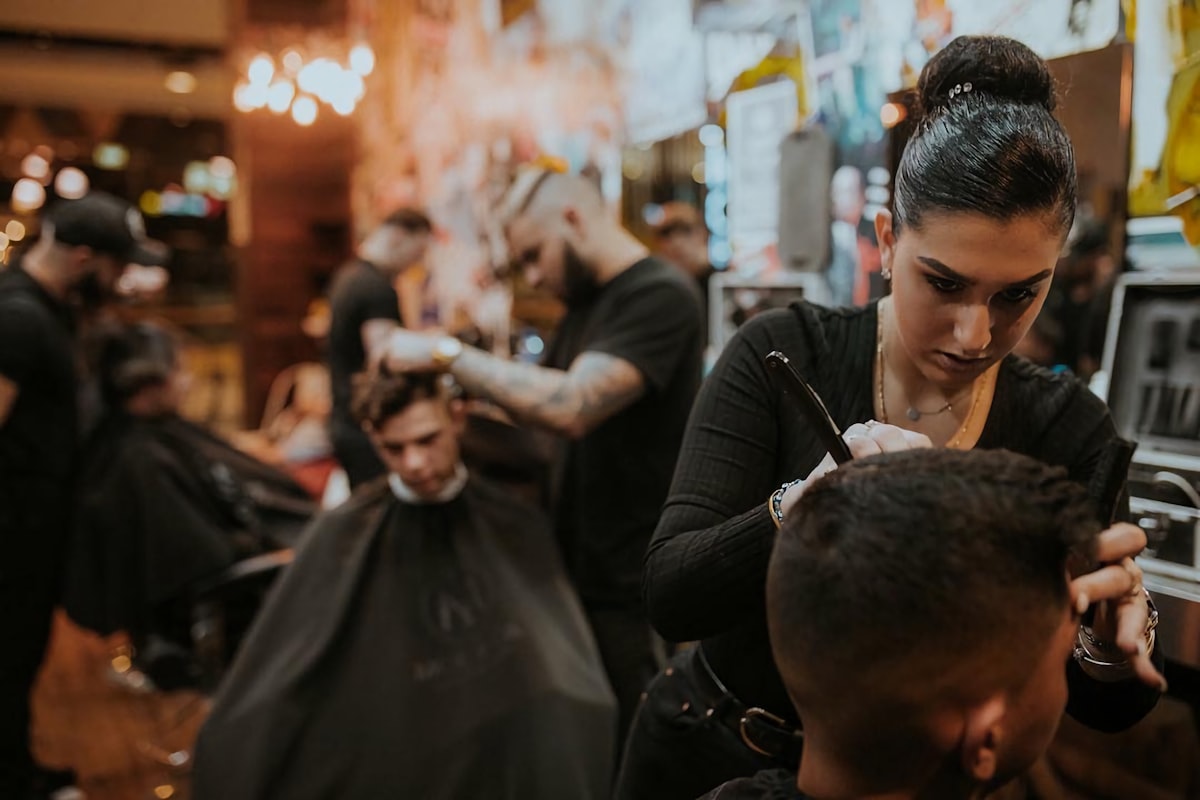
The straight razor is used for shaving rather than cutting. Barbers use it to shave the neckline, clean up around the ears, shape the hairline, and for full-face hot towel shaves. It cuts hair at skin level, producing the cleanest possible line. A straight razor edge lasts one use (barbers use disposable blades for hygiene). The cut it produces is cleaner than any clipper blade.
Scissors
Scissors are used for the top section of most cuts and for any texture work. They allow length adjustment strand by strand and with more precision than clippers for longer hair. Thinning shears (scissors with one serrated blade) remove bulk from thick hair without reducing length significantly, the serrated blade cuts only some of the hair in the grip, reducing volume.
Combs
Barbers use multiple comb types. A wide-tooth comb detangles and sections hair. A fine-tooth comb guides clipper and scissor work for precision cuts. A tail comb (with a pointed handle) creates precise parts and sections. Combs also protect the client's scalp from direct blade contact during clipper work.
CADMEN Training
CADMEN Barber Academy teaches full tool mastery from day one. academy.cadmen.ca/in-person-training.
Frequently Asked Questions
Why do barbers switch between multiple pairs of clippers during a cut?
Different clipper models and blade configurations produce different results, and professional barbers use specific tools for specific parts of the cut rather than one clipper for everything. The most common reasons for switching: different blade sizes for different sections. A full-size clipper runs efficiently through long hair for bulk removal in the early stages of a fade. A smaller, lighter clipper with a tighter blade may be preferred for the close fade work at the low grades. Detailer/T-liner for line work. As described above, the narrow head of a detailer produces clean lines that a full clipper physically cannot. Most barbers switch to a T-liner for all edge work regardless of what clipper they used for the fade. Clipper versus trimmer for specific areas. Some barbers prefer a specific trimmer for neckline work because of the handle angle or blade width. Blade maintenance reasons. During a cut, if a clipper blade gets dull or hot (clippers generate heat during continuous use), switching to a backup prevents discomfort to the client and maintains cut quality. Professional barbers typically have the same clipper in multiple pairs so they can alternate and allow each one to cool. Brand-specific performance preferences. Wahl, Andis, Oster, and BaByliss all produce clippers with slightly different blade behaviors, weights, and power levels. Barbers develop preferences for specific tools for specific tasks based on their own technique. A barber reaching for a second set of clippers is a professional making a precise tool choice, not an indicator that the first tool failed.
What is a barber comb used for versus a regular comb?
Barber combs are specialized tools designed for professional cutting technique. They differ from standard personal-use combs in specific ways that matter for barbershop work. The cutting comb: the most common professional tool, also called a clipper comb or styling comb. It has two sections, one with widely spaced teeth for sectioning and detangling, and one with closely spaced teeth for precision work. The fine-tooth end is used to lift and guide hair against the scissors or clippers for length measurement. The teeth act as a guide to cut at a consistent length along a section. Flat distribution is essential: the teeth need to penetrate through the hair evenly. This is why barber combs are typically made from hard carbon or cellulose acetate (they slide through damp hair cleanly) rather than flexible plastic (which bends and distributes inconsistently). The pick comb (or Afro comb): used to lift and separate curly or coily hair that a flat comb cannot penetrate without pulling. Essential for textured hair work. The tail comb: a standard-width comb with a pointed metal or plastic "tail" handle. The tail is used to create precise part lines and to section hair cleanly. The tail produces a perfectly straight line that a fingernail or a regular comb cannot replicate consistently. A standard personal comb could theoretically be used for cutting work, but the manufacturing standards are lower (inconsistent tooth spacing, flexible plastic that bends under pressure), the tooth spacing is not optimized for the two-section approach that professional cutting technique uses, and the materials are less durable under continuous professional use. The professional comb is an inexpensive tool that produces consistent results at scale.
Can clients bring their own tools to a barbershop appointment?
Clients can bring their own tools, but there are specific scenarios where this is practical and scenarios where it is not. Scenarios where bringing your own tools makes sense: specific product for your hair type that you want applied at the end of the service. If you have a particular clay, pomade, or cream that works well for your hair and you want the barber to use it for the styling finish, bringing it is entirely reasonable. Most barbers will use it without any issue. Skin-sensitive clients: if you have known reactions to specific products (fragrances, certain aftershaves) and want to use your own, bringing and asking the barber to use it is appropriate. What does not make sense to bring: your own clippers, scissors, or combs. The barber's professional tools are calibrated for their specific technique. Introducing a client's clippers would require the barber to recalibrate the blade tension, potentially produce different results, and raise hygiene questions (are the client's tools clean and sanitized to professional standards?). A barber is not obligated to use a client's tools, and most would decline. Your own straight razor: professional barbershops use single-use disposable blades or properly sterilized tools for every client. Bringing your own razor introduces sanitation questions and most shops have strict protocols about the tools used in the service for health code compliance. The practical summary: products are welcome, tools are not, and asking in advance is always appropriate if you are uncertain whether a specific item is welcome at the shop you are visiting.
Related Reading From CADMEN Barber Academy
- The Top 5 Most Important Tools to Have in Your Barber Beginner Kit
- Barber Tools: What Professional Barbers Use and Why
- What Tools Do You Need to Start as a Barber: The Starter Kit That Covers Every Cut
- Barber Tools List: Every Piece of Equipment a Professional Barber Needs
- Barber Tools Explained: What Every Instrument in the Shop Actually Does
- Beginner Barber Tools: What You Actually Need and What to Buy Later
