Scissors vs. Clippers for Men's Haircuts: When Barbers Use Each
Scissors vs. Clippers for Men's Haircuts: When Barbers Use Each
Most men's barbershop haircuts use both scissors and clippers, with each tool serving a different role in the cut. Understanding which tool does what explains why certain parts of a haircut are approached differently and helps you communicate more precisely about what you want.
What Clippers Do
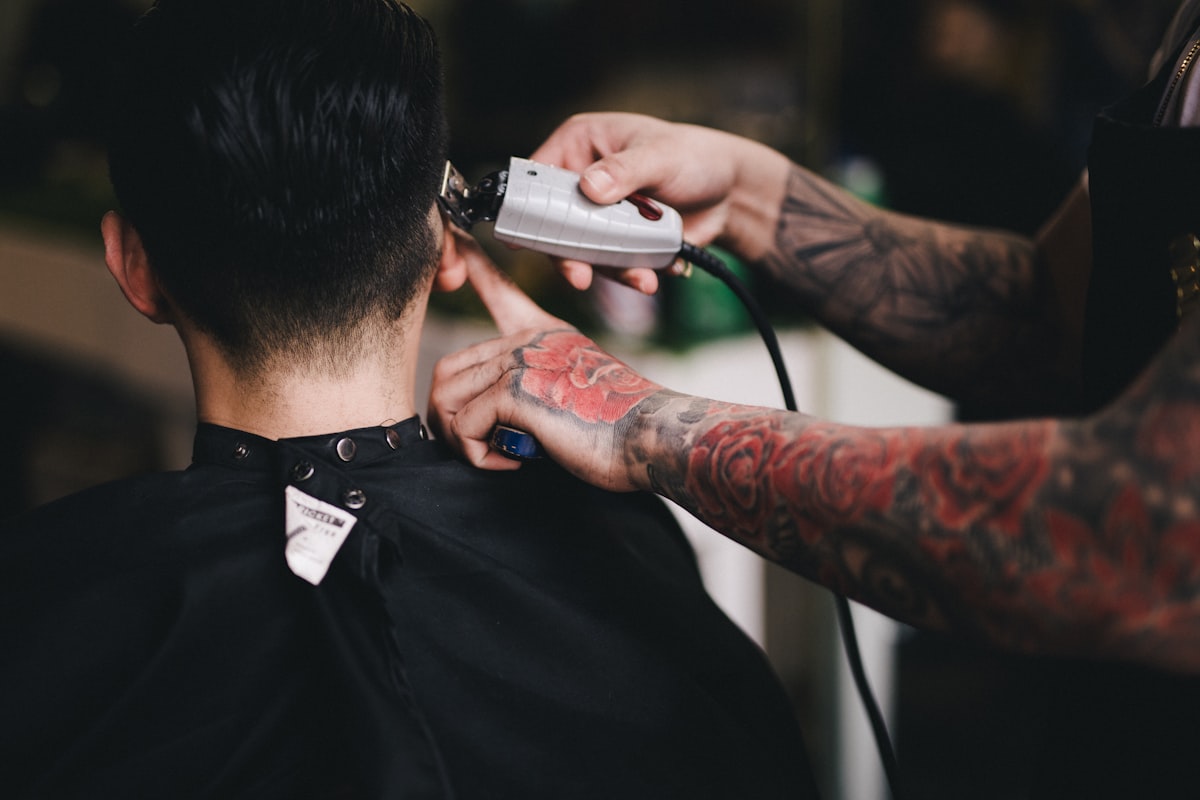
Clippers are electric cutting tools with blades that move rapidly back and forth. They are fast, consistent, and efficient at removing large amounts of hair quickly. Clippers with guards remove hair to a precise, consistent length across an area. Clippers without guards (or with very close guards) can take hair to skin level. They are the primary tool for fades, tapers, buzz cuts, and any part of a haircut requiring close, graduated side or back treatment. Clipper work is faster than scissor work for the same amount of material and is the standard tool for everything from the ears down in most men's cuts.
What Scissors Do
Scissors provide more control than clippers for specific types of cutting. Point cutting — cutting at an angle into the tips of the hair — creates texture and softness that a clipper guard cannot replicate. Scissor-over-comb technique (holding a comb at a specific angle and cutting along it with scissors) allows precise blending and shaping in areas where a clipper guard would leave the cut too blunt. Scissors are the primary tool for the top section of most haircuts, for layering, for texturizing thick hair, and for any part of the cut where subtle, hand-controlled reduction is needed rather than guard-defined length.
When Barbers Switch Between Them
A typical men's cut starts with clippers on the sides and back (defining the fade or taper), moves to scissors for the top section (cutting length, adding texture), and may return to clippers or use clipper-over-comb for blending the transition between the side treatment and the top. Detail work (neckline, behind the ears, the hairline) may use trimming clippers (cordless smaller tools) rather than full-size clippers for precision.
CADMEN Training
Scissor and clipper technique are both foundational skills at CADMEN Barber Academy. academy.cadmen.ca/in-person-training.
Frequently Asked Questions
Is a scissors-only haircut better for men?
A scissors-only men's haircut is not inherently better or worse than a cut that uses both scissors and clippers — the right approach depends on the style being cut and the result you are looking for. When scissors-only is the right tool: longer men's cuts (4 inches or more) where the goal is layering, movement, and texture. Scissor work produces the most natural, textured result for longer hair because the barber can make precise, controlled decisions about how much length to take and where. Styles that specifically require a soft, blended, natural look rather than clean geometric lines and defined fades. Men with certain hair textures (very fine hair) where clipper edges can look too blunt and harsh — scissor work on fine hair produces softer transitions. When clippers are the appropriate primary tool: any style involving a fade, taper, or skin-close side treatment. Clippers with guards produce the consistent, graduated lengths required for fade technique far more efficiently and consistently than scissor-over-comb alone. Shorter haircuts (buzz cuts, crew cuts, any uniform short-guard cut) where the result is defined entirely by length, not texture. The misconception: the idea that scissors are more premium or skillful than clippers comes from a context difference. In women's haircut culture, scissors are the standard precision tool and clippers are associated with budget cuts. In men's barbershop culture, clipper mastery is the primary skill — good clipper work is just as technically demanding as good scissor work. A barber who produces clean, smooth fades with clippers is demonstrating high skill, not a shortcut.
What is clipper-over-comb and when is it used?
Clipper-over-comb is a barbering technique where the barber places a comb against the scalp at a specific angle and runs the clippers over the top of the comb, cutting only the hair that extends above the comb teeth. The comb acts as a variable guide — changing the comb's angle changes how much hair is cut and how the transition appears. This technique is used primarily for: blending the transition zone in tapers and fades. Clipper guards produce clean, defined lengths, but between guard sizes there can be visible lines. Clipper-over-comb allows the barber to blend these transitions smoothly, creating the continuous gradient that characterizes a good fade. The neckline and sideburn area. These sections often benefit from the fine control of clipper-over-comb rather than a fixed guard, because the natural hairline shape requires a technique that adapts to the contour rather than cutting to a fixed length. Shorter haircuts on longer hair. Men who prefer not to use guards (wanting the barber to cut to visual judgment rather than mechanical length) use scissor-over-comb for the top section and clipper-over-comb for the sides. This is common in traditional barbershop service. The skill dimension: clipper-over-comb is one of the techniques where experience shows most clearly. A barber with deep clipper-over-comb skill can blend seamlessly; a barber without that depth leaves choppy transitions or visible lines at the guard-change points. Watching a barber's clipper-over-comb work when assessing a new shop tells you a lot about their overall skill level.
Why do some barbers charge more for scissor cuts?
The pricing difference for scissor-heavy cuts versus clipper-based cuts has two real justifications: time and skill specialization. Time: scissor work on longer hair is significantly more time-intensive than clipper work. A full scissor cut on medium-length hair (2 to 4 inches throughout) can take 30 to 45 minutes just for the cutting phase. A clipper-based men's cut of the same duration covers more ground because clippers remove large sections quickly. A barbershop pricing haircuts purely on time rather than service type would naturally arrive at higher prices for scissor-heavy work. Skill specialization: men's barbers who focus primarily on clipper work — fades, tapers, short cuts — may have less developed scissor technique for longer, layered men's work. Barbers who specifically market scissor cuts for men have invested in developing that skill and often charge a premium reflecting the specialization. In a market where clipper-based fades are the majority of men's barbershop work, a barber with strong scissor skills for longer cuts is offering something genuinely differentiated. The practical consideration for clients: a higher price for a scissor cut is warranted when the barber has the skill and experience to justify it. Paying the premium for a specialist who produces excellent results on longer or more complex cuts is reasonable. Paying a premium for a basic scissor trim that takes the same time as a clipper cut is not. Look at the barber's portfolio for the specific service you want before committing to the appointment.
