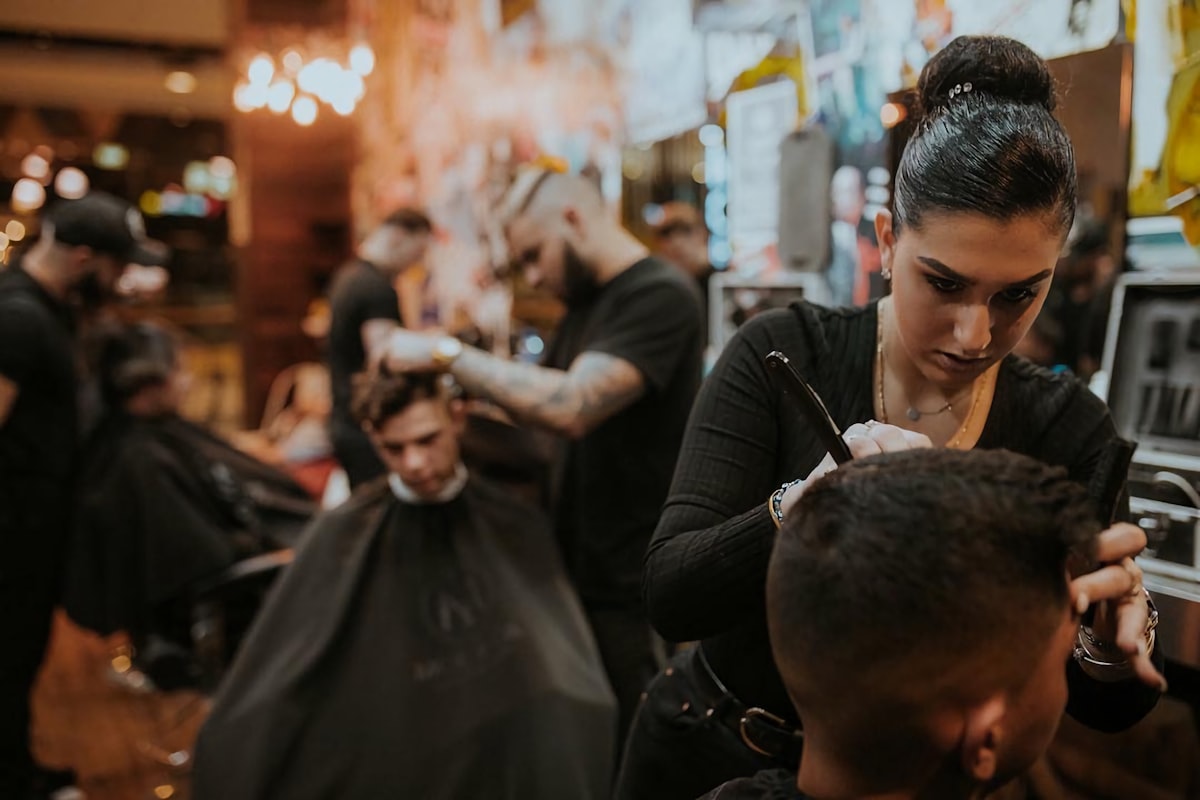
Scissor Over Comb: What the Technique Is and When Barbers Use It
Scissor Over Comb: What the Technique Is and When Barbers Use It
Scissor over comb is a barbering technique where the barber holds a comb against the head to lift the hair to a consistent length, then cuts the hair that extends above the comb with scissors. The comb acts as a guide in place of a clipper guard, and the scissor removes the hair above the comb line. This technique is foundational in traditional barbering and produces results that differ in texture and appearance from clipper cutting.
How It Differs from Clipper Cutting
Clipper cutting uses a mechanical blade to cut every hair that reaches the guard length in a single pass. Scissor over comb requires multiple passes as the barber moves the comb through different sections, cutting as they go. The result with scissor over comb tends to have more texture and a slightly softer finish than clipper cutting at the same length. The individual hair ends are cut at a slight angle by the scissor movement rather than blunt-cut across the full width by a clipper blade. This produces a less uniform but often more natural-looking result.
When Barbers Use It
Scissor over comb is used most commonly on the back and sides for blending and graduation when a softer finish is desired, on the top section for cutting medium to longer lengths without a clipper, and for specific textures (very coarse or very fine hair) where the barber wants more tactile control over the cut than clippers provide. Traditional wet cuts at full-service barbershops use scissor over comb throughout rather than relying primarily on clippers.
CADMEN Training
Scissor over comb and advanced scissor technique are core skills in CADMEN's hands-on barbering program. academy.cadmen.ca/in-person-training.
Frequently Asked Questions
Is a scissor haircut better than a clipper haircut?
Whether scissors or clippers produce a better result depends on the specific haircut, hair type, and the outcome you are looking for. There is no categorical answer — both tools have specific advantages. What scissors do better: for longer hair lengths (anything over about 1.5 inches on top), scissors provide more precision and control over the final shape. A barber cutting with scissors can remove small amounts at a time and evaluate the shape continuously. Scissor work produces softer, more graduated edges at the ends of the cut. The hair ends have a more natural, tapered finish compared to the blunt cross-section produced by clipper blades. For textured cuts, point cutting, and layering, scissors are the primary tool. Layering requires cutting different sections to different lengths, which is done with scissors. For cuts where the final shape needs to be customized to the individual head shape rather than following a guard length, scissors give the barber more flexibility. What clippers do better: for short cuts (under about 1.5 inches), clippers are faster, more consistent, and produce results that match guard lengths with high repeatability. When you come back and ask for "the same thing as last time" with a guard length, a clipper-based cut is easily reproducible. For fades and blends between very short lengths at the sides, clippers (particularly finishing clippers with fine blades) are more precise than scissor over comb in the very close ranges (guard 0 to 2). For clients who want a clean, uniform close cut, clippers produce a crisp result efficiently. The realistic assessment: most skilled barbers use both in the same haircut. A typical fade haircut uses clippers extensively on the sides and back (for the fade graduation and close cutting), then transitions to scissors for the top section at longer lengths, point cutting, and final shaping. Scissor over comb bridges the two — using the scissor tool but mimicking the gradient control of clippers. Requesting "scissor cut only" means something specific at some barbershops (traditional, longer, no-clipper approach) and is a reasonable request if that is what you want.
What is point cutting and when is it used?
Point cutting is a scissor technique where the barber holds the scissors vertically (or at an angle) and makes small vertical cuts into the ends of the hair rather than cutting straight across horizontally. The scissors enter the hair "point first" at the cutting edge, creating a notched, textured end rather than a blunt line. When and why it is used: point cutting removes some hair from the ends while breaking up the uniformity of a blunt cut line. The result is a softer, more textured finish at the ends of the cut. Point cutting is used to add texture and movement to hair that would otherwise look too blunt or heavy if cut straight across. It is particularly useful for thick or dense hair, where a blunt horizontal cut can look heavy and block-like at the ends. By removing some material from the ends while leaving others slightly longer, point cutting creates graduation that the eye reads as natural-looking texture rather than a manufactured line. It is also used to remove "bulk" from the interior of the top section — cutting into the middle of the section rather than just the perimeter to reduce weight without changing the overall length visible from outside. What point cutting does not do: it does not significantly reduce the overall length. Point cutting is a finishing and texturizing technique, not a length-reduction technique. If you want less length, that happens through the primary cutting pass. Point cutting refines the result afterward. Who benefits from point cutting: men with thick, coarse, or dense hair who find their haircut looks heavy or stiff after a standard blunt cut. Men who want visible texture and movement in the top section rather than a clean, uniform finish. Men growing their hair out who want the ends to look natural rather than freshly blunt-cut.
Should I ask for a wet or dry haircut?
The wet vs. dry distinction in haircuts refers to whether the barber cuts the hair while it is wet (after washing or wetting) or dry (as it sits naturally). Each approach has specific use cases. Wet haircuts: when hair is wet, it stretches slightly and lies flat, making it easier for the barber to see the exact length and create uniform, clean cuts. Wet cuts are the standard for scissor-based work on longer hair. The barber has more control over the exact line and graduation because the hair is predictable in its behavior. Wet cutting tends to be the approach for more structured styles — anything where the final shape is carefully cut to a specific form. The consideration: wet hair looks shorter than dry hair (the water adds weight and draws the hair down). This means a barber cutting wet hair must account for the fact that the hair will appear slightly longer once dry. Experienced barbers calibrate for this. Dry haircuts: cutting dry hair allows the barber to see exactly how the hair naturally falls, where it naturally parts, and how it behaves without water weight. For wavy, curly, or textured hair, dry cutting is increasingly preferred because the barber can see and work with the hair in its natural state rather than cutting it in a flattened, wet state that does not reflect how it will actually look. Dry cutting also allows real-time assessment during the cut — the barber can see the shape forming as it would look in the finished state, rather than making decisions based on how wet hair is responding. Which to ask for: for very short, clipper-based haircuts (fades, buzz cuts, short crew cuts), wet vs. dry is largely irrelevant — the clipper guard determines the length. For medium to longer scissor-based cuts on straight hair, wet is the traditional standard. For wavy, curly, or textured hair at medium to longer lengths, asking specifically for a dry cut is worth considering, and many barbers who specialize in textured hair prefer dry cutting for these textures.
