The Men's Quiff: How to Cut and Style It
The Men's Quiff: How to Cut and Style It
The quiff is defined by volume and lift at the front of the hairline, with the hair swept upward and often slightly back or to one side. It is one of the more adaptable men's hairstyles: styled with pomade and a comb it reads classic and polished; styled with paste and fingers it reads modern and textured. The same underlying cut can produce both looks.
What Makes a Quiff
Three elements define a quiff:
- Length at the front hairline: The hair at the forehead needs to be long enough to stand up and be swept back. 2.5 to 4 inches at the front is the typical range. Shorter than 2 inches lacks the length to achieve the volume characteristic of the style; longer than 4 inches can work for dramatic quiffs but requires more product and blow-drying effort to maintain.
- Volume at the crown: The quiff creates height from the crown forward. The cut should preserve enough length from the forehead to the crown to allow this upward sweep.
- Shorter sides and back: Almost universally, the quiff is paired with shorter sides, a taper, fade, or disconnected undercut, to create the visual contrast that makes the front volume stand out. A quiff on uniformly longer hair reads more like a grown-out style than an intentional quiff.
Cutting the Quiff
Sides and back
Cut with standard taper or fade technique. The height and tightness of the sides is the first decision to confirm with the client. A low taper quiff is more conservative; a high skin fade quiff is more modern. Either works; the client's preference and lifestyle determine which.
Top and front
The top section is cut with scissors and a comb. Section the hair from front to crown and assess the length needed for the desired quiff height. Cut in the direction the hair will be styled, forward and upward from the back toward the front. The front section (first inch back from the hairline) should be the longest point on the top, since this is where the volume and sweep will be most prominent.
Use point cutting at the front to add texture and softness to the quiff tips. Blunt-cut front sections produce a stiffer quiff profile; point-cut sections produce a more natural, textured look when styled.
The graduation from shorter crown to longer front is gradual, there should be no visible step or ledge when the top is viewed from the side.
Styling the Quiff
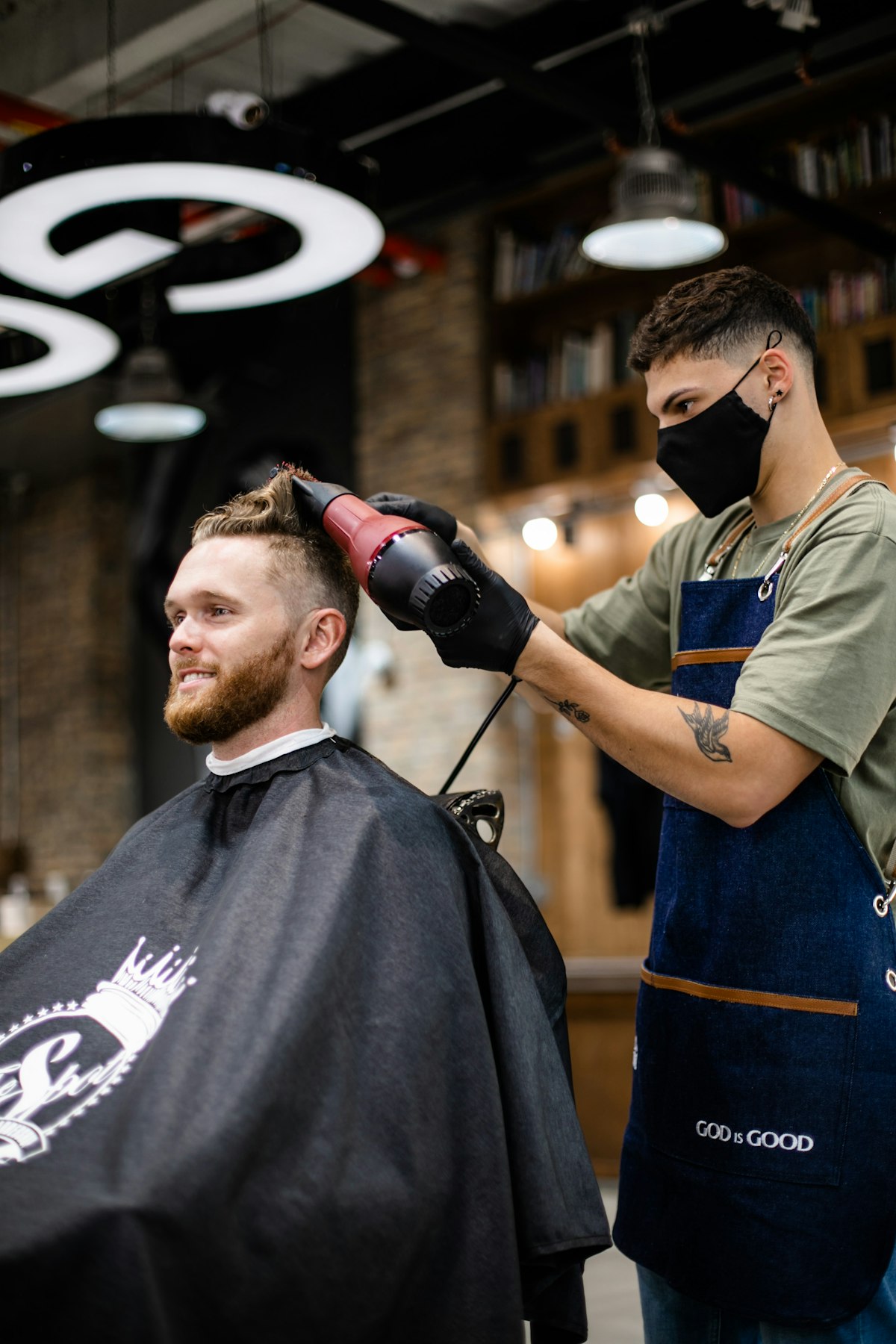
The quiff is shaped with a blow dryer and product. Without blow-drying, the front section will fall flat or to one side. Blow-drying is not optional for this style, it is part of the service.
Blow-drying technique
Apply a small amount of styling product to towel-dried or barely damp hair. Use a round brush or paddle brush to lift the front section forward and upward while aiming the blow dryer at the root. Lift at the base, not the tip, it is the root lift that creates the quiff height, not the product on the mid-lengths. Work from the back of the top section forward, directing the hair toward the front hairline throughout.
Product choices
- Volume powder or mousse applied before blow-drying: Adds root lift for fine or flat hair that does not naturally hold volume.
- Medium hold paste or clay: Applied after blow-drying for a textured, modern quiff. Worked through with fingers for a relaxed finish.
- Pomade (water-based): Applied after blow-drying for a clean, slick quiff. A comb used to define the front sweep adds the classic polished look.
- Light hairspray over the finished style: Extends hold for the full day, particularly important for finer hair that relaxes quickly.
Face Shapes and the Quiff
The quiff adds vertical height to the face. This makes it particularly flattering on round or square face shapes, where the added height elongates the face visually. On long or rectangular face shapes, a quiff with less dramatic height and more width at the sides tends to be more proportionate. The tightness of the side fade also plays into this, high skin fade on a long face can accentuate the length; a softer taper gives more visual balance.
CADMEN Training
Styling, top section cutting, and the full men's cut framework are covered in the CADMEN hands-on program. academy.cadmen.ca/in-person-training.
Frequently Asked Questions
What is the difference between a quiff and a pompadour?
Both styles feature volume at the front of the head, but the direction and positioning differ. A pompadour sweeps all the hair backward from the hairline, creating a rounded, elevated silhouette with the peak of the volume directly above the forehead. A quiff sweeps the front section upward and slightly forward or to the side, creating a more angular lift with the volume at the front hairline rather than behind it. The pompadour has a rounder, more voluminous profile overall; the quiff is typically sharper and more frontal. In practical terms, the two names are used somewhat interchangeably in some markets, but a strict definition separates them by the sweep direction and peak position.
Does the quiff work on fine hair?
Yes, but it requires more effort to maintain the volume. Fine hair lacks the natural density to hold root lift through the day. The workarounds: use a volumizing mousse or powder at the roots before blow-drying, blow-dry at higher heat with more aggressive root lift technique, and finish with a light hairspray to lock the volume. A medium-hold paste with a light hairspray top coat tends to hold fine hair in a quiff better than heavy pomade, which can weigh fine hair down. For clients with very fine hair, the barber should mention during the consultation that styling time is a real commitment for this style and confirm they are willing to invest the time each morning.
How do you get volume for a quiff?
Root lift during blow-drying is the primary technique. While the hair is damp, use a round brush to lift the front section upward at the roots and direct the blow dryer at the root area (not the tips). The hot air at the root, combined with the brush lifting against the growth direction, sets the hair fibers in an upward direction. Once the hair is cool in that position, the volume holds. Product applied before or after blow-drying amplifies this effect. Air-drying a quiff without blow-drying rarely produces adequate volume, the hair dries in whatever direction gravity takes it.
What length is needed for a quiff?
At minimum, 2 inches at the front hairline. A quiff that reads with clear definition and styling flexibility starts at about 2.5 inches. Most quiffs on clients who prefer a prominent, styled look are cut to 3 to 4 inches at the front. Longer lengths (4+ inches) allow for dramatic quiffs but require proportionally more styling time and product to maintain. Confirm the desired quiff height with the client and work backward from that to determine the minimum front length needed to achieve it.
How long does a quiff hairstyle last between haircuts?
3 to 5 weeks for most clients. The quiff depends on the length at the front staying in the 2.5 to 4 inch range, once it grows past that into a longer length, the volume and sweep become harder to control and the style starts to look overgrown rather than intentional. Clients who want to maintain the quiff consistently tend to book every 3 to 4 weeks. Clients who are less precise about maintenance can stretch to 5 to 6 weeks before the quiff clearly needs a refresh. The sides require attention at a similar or slightly shorter interval, depending on how tight the fade is.
Related Reading From CADMEN Barber Academy
- The Quiff Haircut: How to Get It and Style It
- The Quiff Haircut: What It Is and How It Compares to the Pompadour
- The Quiff: How to Wear It and What It Requires
- Choosing a Hairstyle for Your Face Shape: A Practical Guide
- The Quiff: What Makes It Work and How to Style It
- The Quiff Haircut: How to Get It and Style It
Want to learn to cut a quiff yourself? CADMEN Barber Academy teaches cutting hands-on, with an educator beside you. See the barber academy in Mississauga or view in-person classes and send an enquiry.
Watch the free Barbering for Beginners playlist on YouTube.
