The Buzz Cut: What It Is and What Face Shapes It Actually Works For
The Buzz Cut: What It Is and What Face Shapes It Actually Works For
The buzz cut is the most reductive of men's haircuts, the goal is to cut the hair to a uniform or near-uniform short length across the entire head, using clippers. It is one of the most low-maintenance cuts available and has been a military and civilian standard for generations. Here is exactly what it means, what variations exist, and the honest answer on whether your face shape suits it.
What Makes a Buzz Cut a Buzz Cut
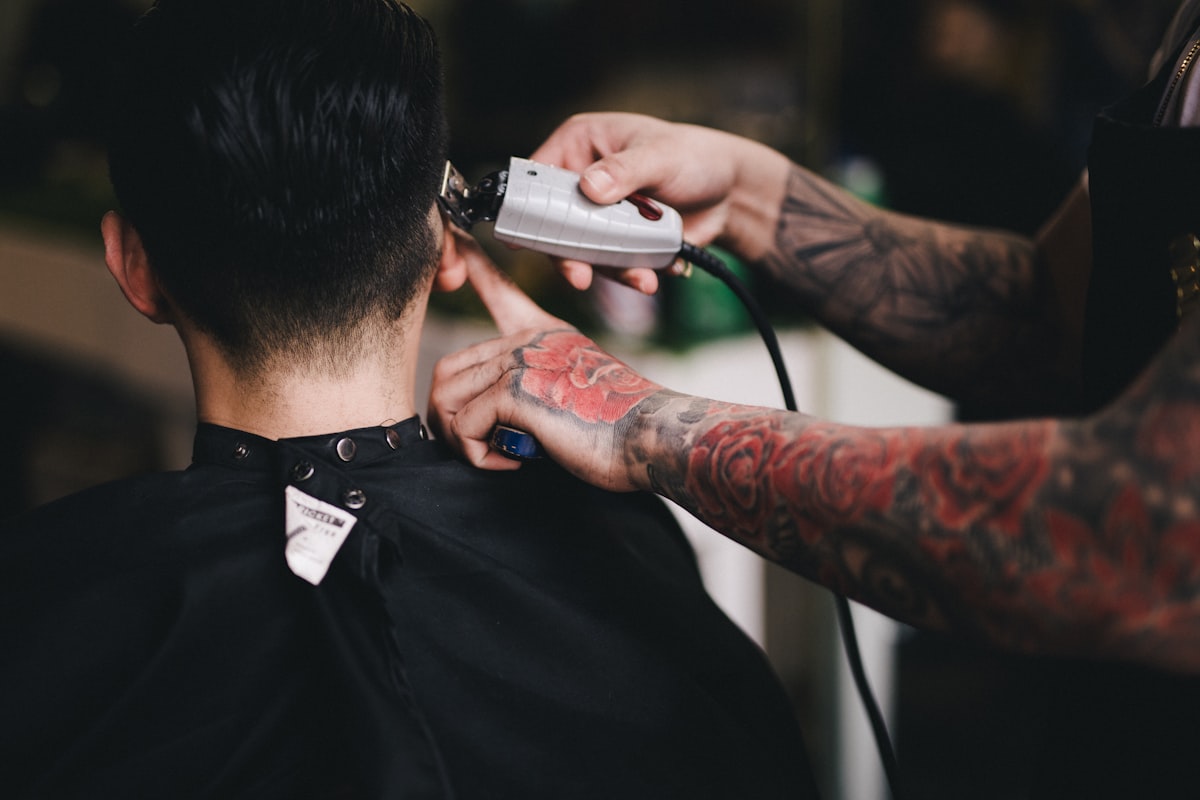
The defining characteristic is uniform length achieved with clippers rather than scissors, with minimal or no fading between sections. The hair is cut to a single guard length (or close to it) all over the head. Unlike a fade, where the length changes from short at the sides to longer at the top, the classic buzz cut uses the same length from hairline to crown.
Buzz Cut Variations
There are several distinct versions: the induction cut (close to skin all over, grade 1 or lower), the burr cut (uniformly very short all over, grade 1-2), and the crew cut (slightly longer on top with a minor taper, this is the variation that blurs into the traditional short back and sides). The number 1 guard is approximately one-eighth of an inch. Grade 2 is one-quarter inch. Most men asking for a buzz cut are asking for a number 2 or 3 all over, which gives a uniform short look with a small amount of visible hair.
The Face Shape Question
The buzz cut removes the hair as a visual element that modifies perceived face shape. Without hair length to add height, create width, or balance proportions, the face's natural shape becomes more prominent. Oval and rectangular faces tend to suit buzz cuts well because these shapes are proportionally balanced without needing modification. Round faces may look rounder because there is nothing adding height. Square faces with strong jawlines are emphasized. Oblong faces may look longer without width. The honest answer: face shape guidelines are general, not absolute. The only definitive way to know how a buzz cut looks on your head is to try it. Hair grows back.
CADMEN Training
CADMEN Barber Academy covers the full range of clipper-based cuts. academy.cadmen.ca/in-person-training.
Frequently Asked Questions
What number guard should I ask for on a buzz cut?
The right guard number depends on how short you want the result and how long you want the cut to last before it needs refreshing. The practical guide: guard 1 (one-eighth inch, approximately 3mm): very close to the scalp. On darker hair, the scalp shows clearly and the hair is very visible. Results are closest to a shaved look while still having some hair present. Grows out noticeably within 1 to 2 weeks. Guard 2 (one-quarter inch, approximately 6mm): the most common choice for a classic buzz cut. Short, clean, and uniform. Scalp is partially visible. Grows out to a reasonable length within 2 to 4 weeks. Guard 3 (three-eighths inch, approximately 10mm): still a short, clean look but with more visible hair. Less scalp showing. This length starts to look like a longer version of a very short cut rather than a traditional buzz. Can last 4 to 6 weeks before it needs refreshing. Guard 4 and higher: these start moving away from the buzz cut aesthetic toward a short uniform cut. Still clean and low-maintenance but no longer strictly a buzz. Starting point recommendation: if you have never had a buzz cut before and are uncertain, guard 2 is the most common choice and produces the expected result without going to the extremes of guard 1 (which shows scalp clearly) or guard 3+ (which may feel too long for what you were picturing). Ask your barber to cut the sides first to a lower guard and leave the top one number higher if you want a slight variation from the truly uniform all-over look.
Does head shape matter as much as face shape for a buzz cut?
Head shape matters and is separate from face shape. They refer to different things and both affect how a buzz cut looks. Face shape is the silhouette of the face from the front, oval, round, square, rectangular, heart, diamond. Head shape refers to the overall three-dimensional shape of the skull, whether the crown is flat, rounded, pointed, or has any notable bumps or asymmetries. Most men have never thought about their head shape because hair covers it. The buzz cut reveals it. A head with a flat crown may look different at the back than expected. A head with a pronounced occipital bone (the bump at the back of the skull) shows it clearly in a buzz. Asymmetries that hair normally obscures become visible. How significant is this? For most men, head shape is not a major factor, most heads look fine with a buzz cut. The concerns are mostly hypothetical until you try it. For men with notably unusual head shapes (significant flatness at the back or crown, pronounced asymmetry), the buzz cut may not be the most flattering choice. A barber who can see the shape of your head is better positioned to give you this feedback than a general rule. If you are uncertain, asking your barber to assess your head shape before committing to a buzz cut is a reasonable part of the consultation. For men who have had buzz cuts before and know their head shape: you already have the data. For first-timers: the information is only fully available after the cut is done.
Can you do a buzz cut at home or does it require a barber?
A basic buzz cut, uniform length all over with a single guard, is one of the most accessible haircuts to do at home with a consumer clipper set. The process is straightforward: choose your guard number, attach it to the clippers, and run the clippers against the growth direction all over the head. The areas that require extra attention are the back of the head (which you cannot see directly) and the neckline (which requires either a mirror setup or someone to help). What a barber adds to a buzz cut that a home cut lacks: a clean, precise neckline. The neckline is the most visible finishing detail and it requires seeing the back of the head clearly and using a trimmer without a guard for the edge. Most home attempts leave an unclean or uneven neckline that is immediately visible from behind. Even blend from all angles. Running clippers over your own head, you lose angle control in certain areas. The back of the head and the crown especially are difficult to clip at the correct consistent angle without a second mirror setup. Clean fade variation if you want a slight taper rather than a pure uniform cut. The practical recommendation: for a true single-guard all-over buzz with no taper or fade, home maintenance is viable with a good consumer clipper set. For a buzz with a clean neckline and any taper component, a barber will produce a cleaner result. Many men do a home clip between barber visits to maintain freshness, then visit the barber every 4 to 8 weeks for a clean neckline and a proper edge-up.
Related Reading From CADMEN Barber Academy
- How to Cut a Buzz Cut: Guard Selection, Blending, and Common Mistakes
- Buzz Cut Guard Sizes: What Each Length Looks Like and How to Choose the Right One
- Buzz Cut Guard Lengths: What Each Number Does to Your Hair
- Buzz Cut Styles: A Barber's Guide to Every Variation
- The Buzz Cut: Every Variation Explained
- The Buzz Cut: What It Is and Which Version to Ask For
Want to learn to cut a buzz cut yourself? CADMEN Barber Academy teaches cutting hands-on, with an educator beside you. See the barber academy in Mississauga or view in-person classes and send an enquiry.
Watch the free Barbering for Beginners playlist on YouTube.
