The Skin Fade: How Barbers Execute It and What Makes a Good One
The Skin Fade: How Barbers Execute It and What Makes a Good One
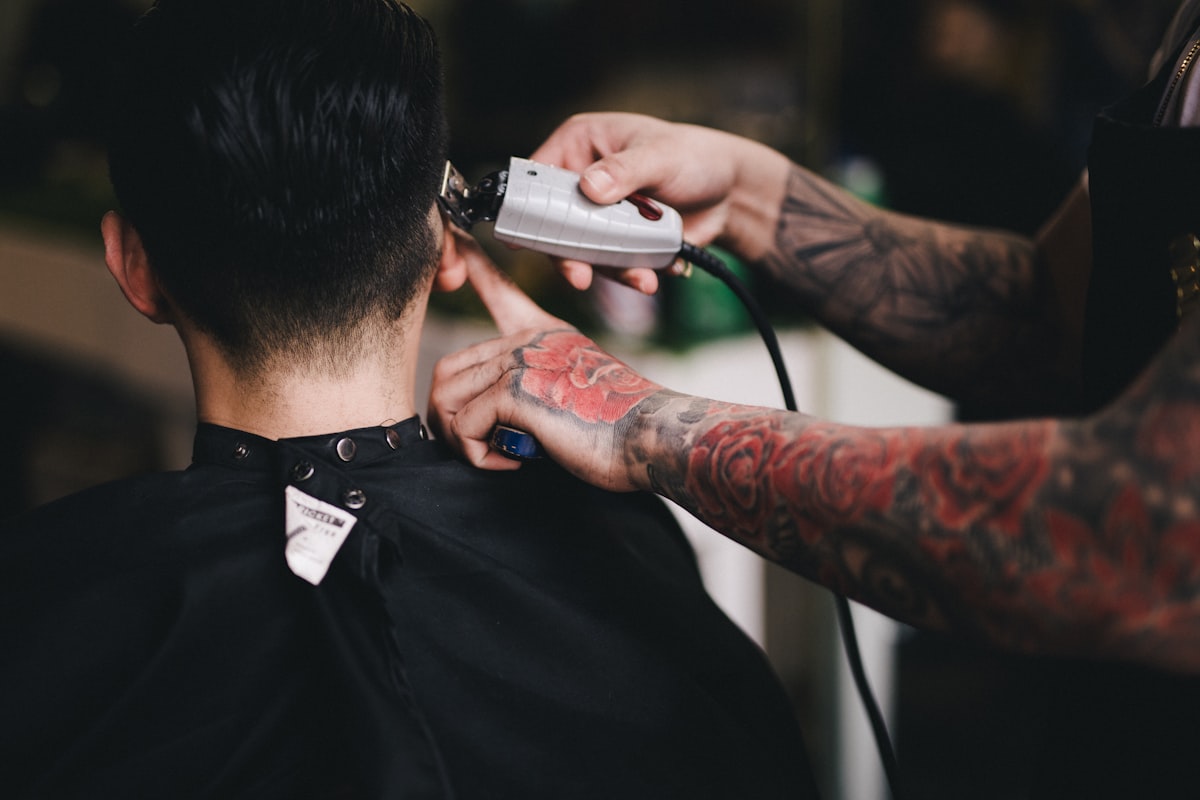
The skin fade is one of the most technically demanding haircut elements in men's barbering. Done well, it appears seamless: a smooth graduation from bare skin at the base to full hair length with no visible lines or steps. Done poorly, the steps between guard lengths are visible, creating a striped rather than blended appearance. Here is how it works.
The Core Process
A skin fade is built from the bottom up. The barber starts at the base of the haircut (neckline, above the ears) with no guard (bare skin) and clippers, and works upward in overlapping passes to establish the lowest point of the graduation. They then work upward with progressively longer guards (typically 0.5, 1, 1.5, 2, and up) in overlapping strokes at each height to create the graduated transition. Each pass slightly overlaps the one below it, blending the lengths at each point of transition.
The final blending step uses a clipper-over-comb technique (running clippers over a comb held against the hair to create a smooth intermediate length) and often a foil shaver or straight razor for the very bottom skin section to ensure the base is completely smooth. The goal is to eliminate any visible line between guard lengths.
What Makes a Quality Fade
No visible lines between guard lengths. This is the primary marker of a well-executed fade. When you can see distinct horizontal bands of different lengths on the sides or back, the barber did not blend adequately between passes. A quality fade reads as a continuous gradient, not a series of steps.
Symmetry. The fade line on both sides of the head should be at the same height and follow the same arc. Uneven fade heights are one of the most common technical errors and are immediately visible in a mirror or photo.
Clean transition to the top. Where the fade meets the longer hair section on top, the transition should be smooth rather than abrupt. This is the most challenging area of the fade technically because it requires blending into the full-length hair above without cutting into it.
Fade Height Terminology
Low fade: the graduation starts just above the ear and above the neckline, and the bare skin zone is small. The result is clean and defined but conservative. Mid fade: starts at approximately the midpoint between the ear and the top section. More visual impact than a low fade. High fade: starts close to the top section, leaving only a narrow band of full-length hair on top. Creates maximum contrast and is the standard for many contemporary styles.
Frequently Asked Questions
How do I know if a barber can do a good fade before committing?
Ask to see their work. Any barber who produces quality fades regularly will have photos or a portfolio. Looking at recent cuts (within the past month) is more relevant than old photos. A barber who is hesitant to show current work or who has no client photos available is a higher risk for a skill level you cannot verify. Online reviews that specifically mention fades are another input.
Why does my fade look uneven a few days after the cut?
Growth is not perfectly uniform across the scalp. The base of the fade grows in faster in some areas than others, particularly along the neckline and above the ears where hair tends to grow quickly. What looked symmetrical at the cut may appear slightly uneven 5 to 7 days later as growth patterns diverge. This is normal and is why fades require more frequent maintenance than non-faded cuts.
Does skin type or skin tone affect how a skin fade looks?
Skin tone affects the visibility of the graduation. On darker skin tones, the contrast between skin and hair is higher, which makes the gradient more visually defined. On lighter skin tones with lighter hair, the contrast is lower and the graduation appears more subtle. Neither is better or worse; they are different visual effects from the same technique.
How long does a skin fade take to execute?
A skilled barber executing a clean skin fade typically spends 15 to 25 minutes on the fade alone, in addition to cutting and styling the top section. Barbers who rush through the fade in under 10 minutes are typically not taking the time needed for adequate blending at each guard transition. Quality blending is time-intensive; it is not possible to shortcut and still achieve a seamless result.
Want to learn to cut a skin fade yourself? CADMEN Barber Academy teaches cutting hands-on, with an educator beside you. See the barber academy in Mississauga or view in-person classes and send an enquiry.
Learn this fade step by step in our free Fade Tutorials playlist on YouTube.
