How Barbers Do an Edge Up: The Technique Behind the Clean Line
How Barbers Do an Edge Up: The Technique Behind the Clean Line
The edge up is the process of defining and sharpening the boundaries of a haircut: the forehead hairline, the temples, and the sideburns. It takes a well-executed haircut from finished to sharp. Here is how the technique works and what determines the quality of the result.
What an Edge Up Addresses
Three primary areas: the forehead hairline, the temple corners, and the sideburns. Each area has a different shape challenge.
The forehead hairline runs from one temple to the other across the top of the forehead. Most natural hairlines are not perfectly straight or consistent. The edge up defines a clean line that follows or refines the natural boundary, either preserving the natural hairline shape or squaring it into a straighter profile.
The temple corners are the right-angle transitions where the front hairline meets the sideburn line. These corners are easy to let become rounded or undefined. A sharp edge up creates clean, visible corners at each temple.
The sideburns run vertically down from the temple toward the ear. Their length and the angle at which they are finished define the side profile of the hairline. Most men's sideburns naturally taper toward a point; the edge up either follows this natural shape or creates a defined square or straight bottom edge.
The Tools
The T-outliner (also called a detailer or liner trimmer) is the primary tool. It is a narrow trimmer with a thin, squared blade designed specifically for creating straight lines and sharp edges. The blade guard can be removed for the closest possible edge, or left on for a slightly less extreme finish.
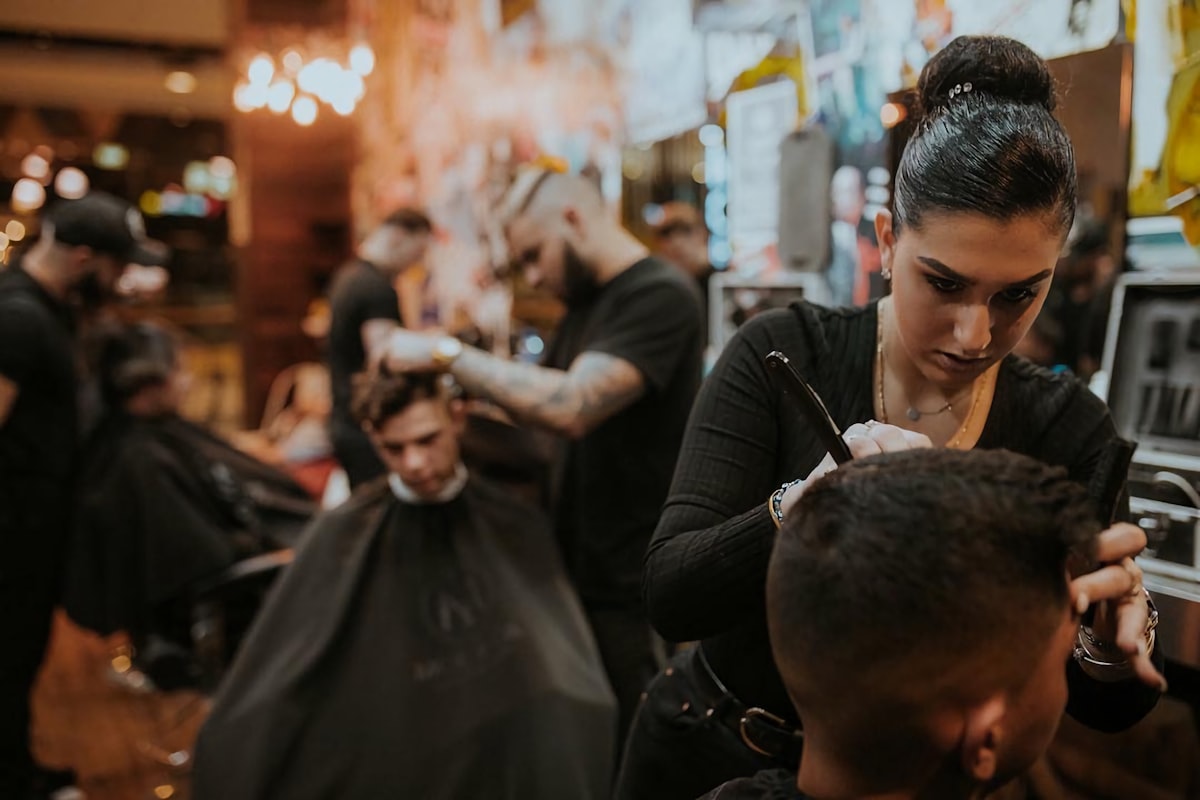
Straight razor work is added after the trimmer in many barbershops to refine the line further. The straight razor with a fresh blade shaves the skin just outside the trimmer-defined boundary, removing fine hairs that the trimmer missed and making the edge visible as a clean contrast between hair and skin rather than a gradient of fine short hairs.
How the Barber Creates the Line
The barber establishes the reference line first. For the forehead hairline, this means identifying the outermost boundary of the dense hair growth and setting the trimmer against that boundary. The blade is positioned parallel to the desired line and moved along it with controlled pressure. Too much pressure on the skin causes the trimmer to cut into the hairline; the correct technique is blade contact with hair, not digging into the scalp.
Temple corners are typically cut by placing the trimmer vertically and then horizontally to create two clean intersecting lines that form the corner. The transition from the forehead line to the sideburn line is where the corner is defined. The barber uses short strokes and checks the angle frequently.
Straight razor refinement follows the trimmer work. The barber stretches the skin slightly for a flat surface, places the razor at the edge of the hairline, and shaves the fine hairs just outside the defined boundary. The result is a clean skin margin between the hairline and the surrounding skin.
What Determines Quality
The steadiness of the blade path, the consistency of the line angle, and the precision of the corners. A skilled barber creates a line that reads as straight from across the room. The corners are crisp. The sideburn length matches symmetrically. A less precise edge up has slight waviness in the line, uneven corners, or different lengths on the two sideburns.
Frequently Asked Questions
How long does an edge up last?
The sharp line begins to blur as the hair at the hairline grows. Most edge ups look sharp for 7 to 10 days and begin noticeably softening at 2 weeks. Men who want a consistently sharp hairline get a standalone edge up every 10 to 14 days between full haircuts.
Can I get an edge up without a full haircut?
Yes. A standalone edge up is a common short service at most barbershops. The price is lower than a full haircut. The service takes 10 to 15 minutes. It is a standard maintenance option for men who grow their haircut out gradually and want to keep the hairline looking fresh between full appointments.
Does the barber change my natural hairline when doing an edge up?
Only as much as needed for a clean line. A barber creating an edge up works just inside or at the natural hairline boundary. They are refining, not redesigning. However, if a barber consistently sets the line slightly inside the natural hairline, the effective hairline moves back slightly over time. A good barber is conservative about where they set the boundary. If you want to preserve your natural hairline, mention this explicitly and ask the barber to define the line at the outermost boundary rather than inside it.
Should the forehead edge be straight or follow my natural hairline curve?
Most men get a slightly squared-off version of their natural hairline: a defined straight or gently curved front line with clear corners. Some men prefer to keep the natural curved hairline shape defined cleanly rather than squaring it. The choice is a preference, not a standard. If you have a specific preference, tell the barber before they begin: once the line is defined in one direction, adjusting it requires cutting into the hair.
Does getting edge ups regularly cause a receding hairline?
The edge up does not cause the follicles to recede. However, if the barber consistently cuts the edge line inside the natural boundary, the apparent hairline moves backward over repeated visits. This is not a biological recession but a cumulative positioning effect. To prevent this, ask your barber to set the line at the very edge of where the hair grows densely, not slightly inside it. Monitoring the line position over successive visits is the practical safeguard.
